
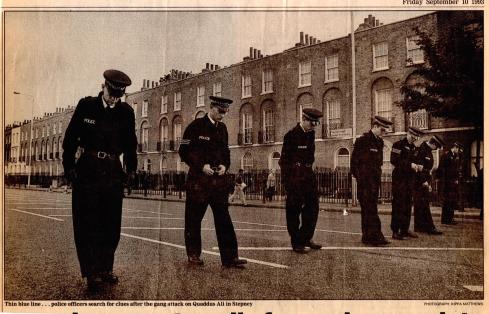
I have been trying to track down photographer Kippa Matthews because I’d like to get permission to use this picture, preferably an original version rather than this one clipped out of a 1993 paper. What I’ve learnt is that all of the photo archivists I have spoken to, at both tabloid and broadsheet papers, are friendly and helpful and interested, but their records are far from complete, especially from the pre-internet years. So far, I have been unable to find out who owns 90% of the press cutting photos I would like to use, including the one of Douglas in his armour on the About page of this blog. If you own any of these photos, please get in touch – I’ve been looking for you.
Anyway, I’ve been trying to get hold of this photo for a slightly esoteric reason. Not because I am interested in Quaddus Ali or gang attacks, but because the photo is one of the last remaining images we have of something that fed our family throughout my teenage years: the quick release buckle. Douglas designed and made thousands and thousands of buckles for the Metropolitan police for several years, and they provided a good source of income whilst he was developing other ideas. But what is so special about this buckle that they needed an inventor to design it?
A normal belt buckle looks something like this:
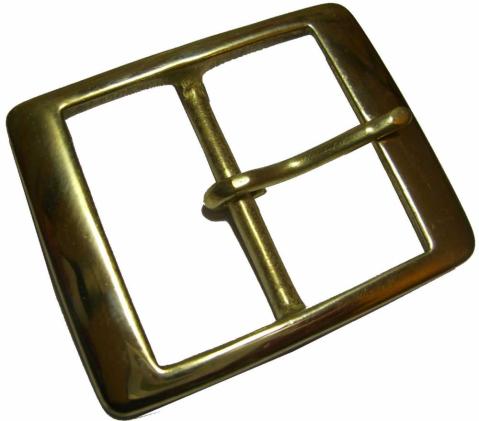
Anyone who has had to do up a belt with one of these buckles in a hurry will know that it can be quite tricky to get the prong to go through the correct hole in the leather strap and you often have to fiddle with it for a few seconds to get it right. That’s fine for a normal pair of trousers, but not for the other type of belt that the Metropolitan Police regularly use: the equipment belt. The one with the handcuffs and truncheon and radio on it. If you are a police person sitting in an office you don’t necessarily wear all of that gear to do your desk work – it’s heavy and annoying and gets in the way – but if you need to respond to a call you want to be able to put your equipment belt on in a hurry as you’re running out of the door. Previous equipment belts had looked something like this:
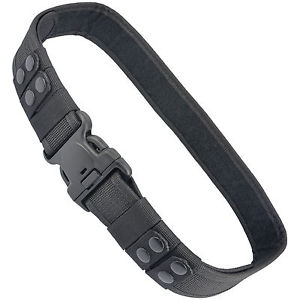 You’ll have seen that type of clasp before, it’s used on all sorts of things from child seat belts to airplanes. And it’s very quick to get on. However, what the police were finding is that enterprising criminals and other rascals would come up to a police person wearing one of these on the street, reach out and Pop! release the buckle before scampering off, leaving the police person with a belt of heavy and expensive equipment crashing round their ankles. This had to stop!
Douglas made a buckle that looked at first glance a lot like the traditional buckle in shape (you can see them if you look closely at the photograph at the top), however, the buckle was just a front, literally, as it had a hook hidden on the back that fitted into a partner plate on the other side of the belt, meaning that whilst it looked normal, it was actually very quick to put on – you just hooked it together – but much more difficult for someone else to figure out if they were looking at it whilst it was on. He teamed up with a leather specialist to make a leather belt that conformed to the current police standards, which meant that when tested, the belt would be strong enough to pull up a person if they fell over a cliff. I love the idea of police officers whipping off their belts to rescue people in such a fashion, and I wonder if the same standard is still true… Either way, we lived on the profits from these buckles, as well as all the standard dress uniform buckles Douglas also sold to the Met, for years, and they helped to establish a relationship with the police and prison services that made some of Douglas’s other ideas possible.
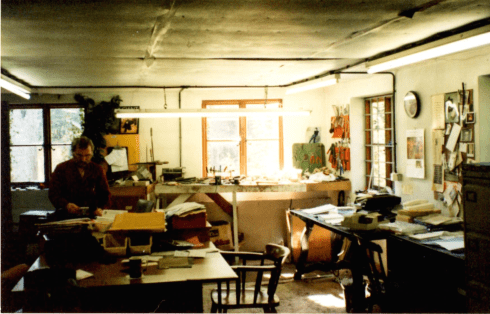
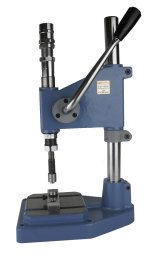 Once the tool was up and running, the pieces could be made and tested, and, one at a time, the tool heads could be changed and the next piece made, and then the next. A Spectangle, for example, would need an individual press action to make the hooks on the strings, another action to fix the hook to the string, another to make the clip for the loops, an action to cut out the three layers of the pendants, another action to press them together, an action to shape the pendant loop and then a final action to press that onto the pendant before you could string them together by hand. Each item could take a long time to make. Only when it was completely assembled could you be sure of whether or not it worked, and that was the point at which he could say, yes, or nope, back to the drawing board, and the cycle would start again. Each product often took years to perfect, although more straightforward items like belt buckles could be done more quickly. All of this development work would have to be done before you had sold a single item, so all of the time and materials had to be paid for before you were sure it would work, and that anyone would want it.
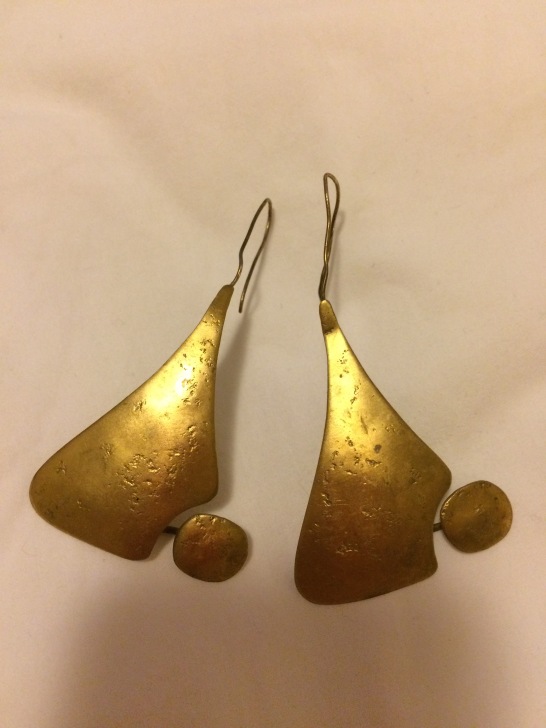
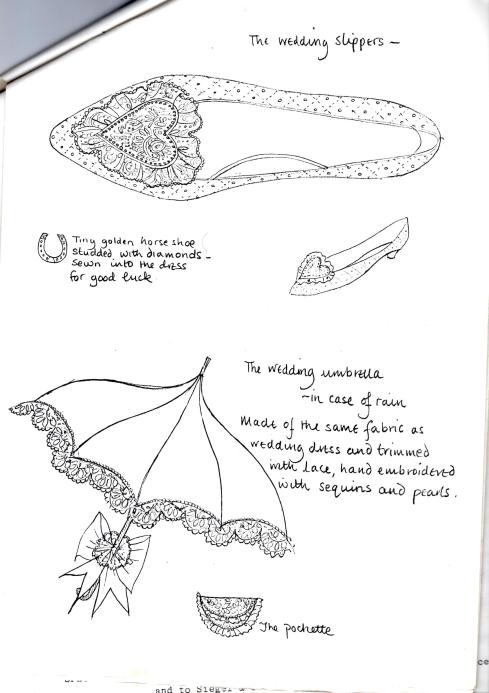
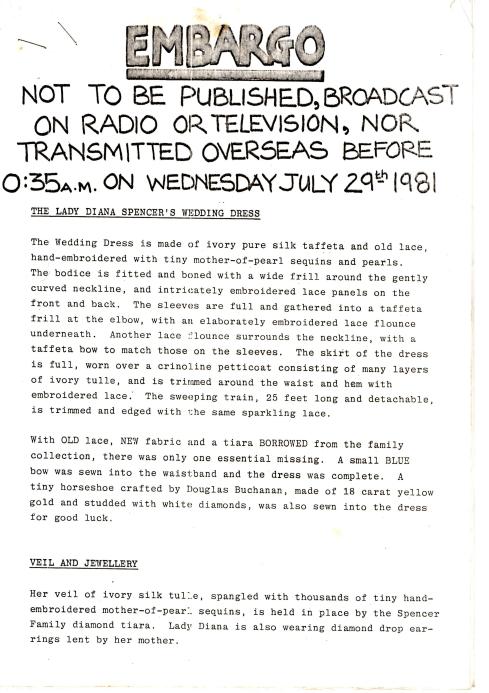 This is a copy of the press release sent out by the fashion designers David and Elizabeth Emanuel who made Princess Diana’s wedding dress, and as you can see, towards the bottom, a familiar name. Douglas was friendly with the Emanuels at the time, and made a small gold horseshoe that was sewn into the bodice of the dress for good luck, as well as the earrings above, which were part of her going-away outfit. The press release shows the Emanuel drawings of the different elements of the wedding dress: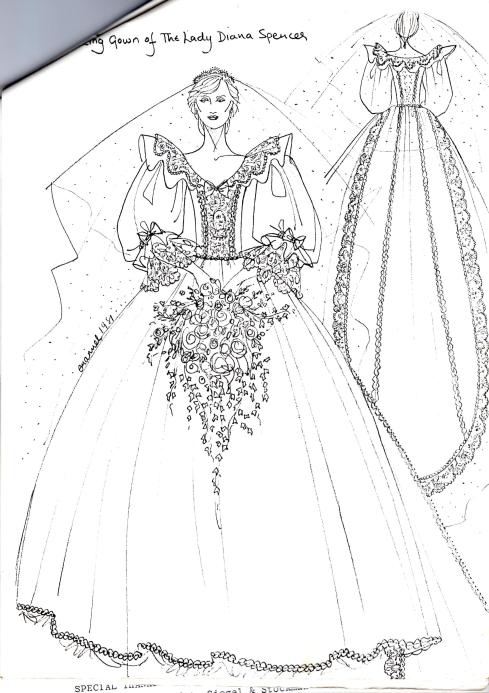
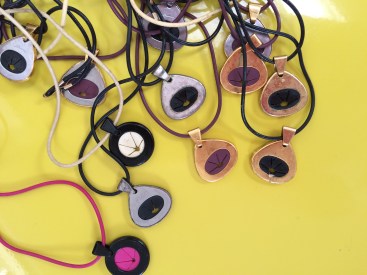 These strange creatures are Spectangles, they are the first of Douglas’s inventions that I saw and, whilst many of his other ideas are much more show-boaty, these probably made more money than most of rest of them, although never very much.
 Traditional glasses cords slide over the arms of your glasses and mean that you can wear the glasses round your neck. Douglas, however, thought that he could do better. With normal cords, the glasses hang badly, clunk around and get in the way, or damaged, and people often just tuck their glasses into the top of their jumper instead (Douglas’s own chosen method). After losing a pair of glasses too many when they fell out of his T-shirt-neck running down some stairs, he got started on a new design, and thus, the Spectangle was born. Using the same hypoallergenic plastic as for the cords, the Spectangle was a pendant with a hole lined with flexible flaps that would hold the arm of your glasses in place, meaning no more accidents. They really worked. Douglas I think wore one almost every day for the rest of his life, and Mum wore one often. By the time I was a teenager he had persuaded the Lakeland catalogue to sell them and I spent many hours in the school holidays working in his workshop with his other staff to cut out and put them together, measuring the cords, clamping the loops and hooks in place, assembling the pendants and pressing them together until they clipped in place before stringing them onto the cords and counting them into bundles. We must have made and sold thousands, and it was with great excitement that I saw my first complete stranger wearing one in the outside world one day. Success at last!
 It seems strange that this is all that is left of my stepfather, who was such a loud and alive person, but here it is, a box of notebooks. I can tell just by looking at it that we don’t have all of them, over the years many of them were lost, damaged, thrown out, abandoned and so this incomplete set is what I have left to work with. It took a few days to go through all of the paper in here, cataloguing each page, working out what was there and what the gaps were. Going through them was a revelation, because, although I had often seen Douglas with a notebook in his hand, I never actually knew what was in them until now. Some of the drawings are damaged and defaced as Douglas, suffering from dementia and Parkinson’s in the later years, cut pages out, drew over drawings and scribbled half-formed sentences over old designs. However, many are intact, and what they show is how Douglas solved problems, played with ideas and worked out how to make his inventions work. He wrote little notes to himself, practiced names, criticised and praised ideas, worked out measurements and drafted and re-drafted shapes. It was clear that he had a tremendous amount of fun doing his work, as well as playing too. Here’s an idea for toilet roll with curved perforations – anyone want to tell me if it would work or not??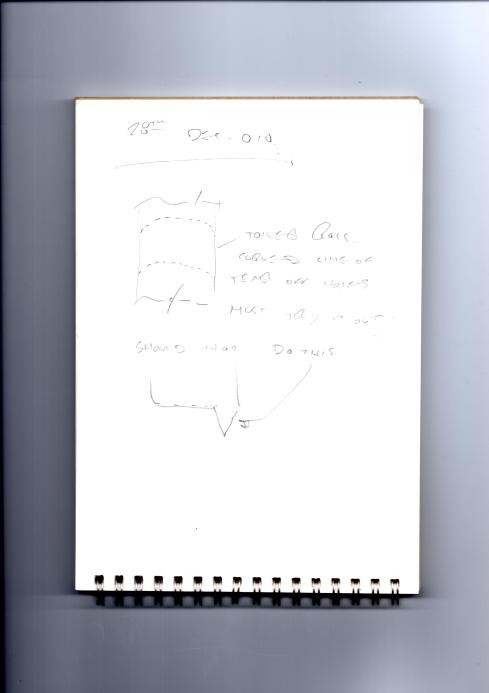
 The Underwater Bike and Other Stories