
As I’ve mentioned before, Douglas, being relatively well-known in the press, attracted all sorts of attention, both good and bad. One of the stories that haunts me the most is about a young man with multiple sclerosis and his father who came to visit Douglas a couple of times back in 1997. They had a problem that they were hoping Douglas could help them to solve. The young man was in his twenties, and was doing his best to live a full and active life despite his condition. He used crutches, not being confined to a wheelchair, and loved to play football. However, the crutches he was using were not up to the job. Here’s your classic crutch:

This is a nice-looking version of the traditional crutch, which first took its present form during World War I; a time when the world suddenly had need of a lot of crutches. The design hasn’t changed much since. There is one other iteration, which looks like this:
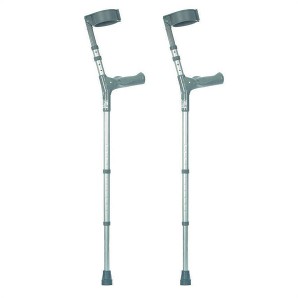
Our visitor used the first kind of crutch, because they are more robust than the second, but they weren’t really up to the job. They caused massive bruising under his arms from him using them to run around on the field, and they kept breaking under the impact of the game, including hitting the football, so they had to keep replacing them. There is limited padding, limited options to adjust them, and very little flex or strength in their design. He and his father hoped that Douglas could design a crutch that could cope with his lifestyle, because he was going to have to use them for the rest of his life. Douglas came up with some initial ideas:
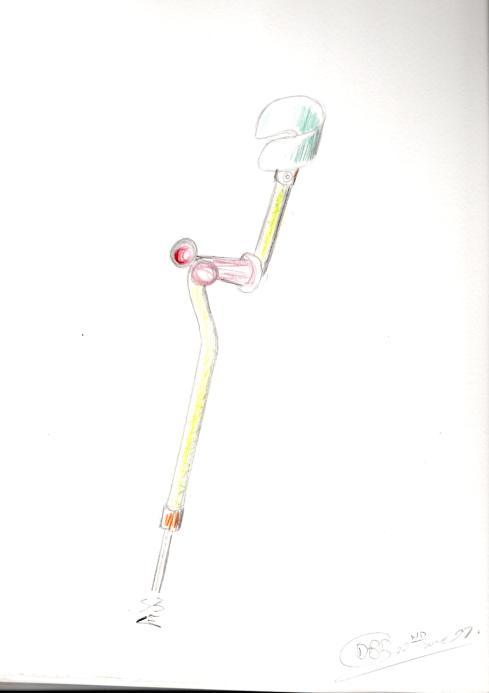

You can see that he was thinking about shock absorbing, about padding or more comfortable handles, about angles and how the body moves. He also had a go at the traditional underarm crutch:
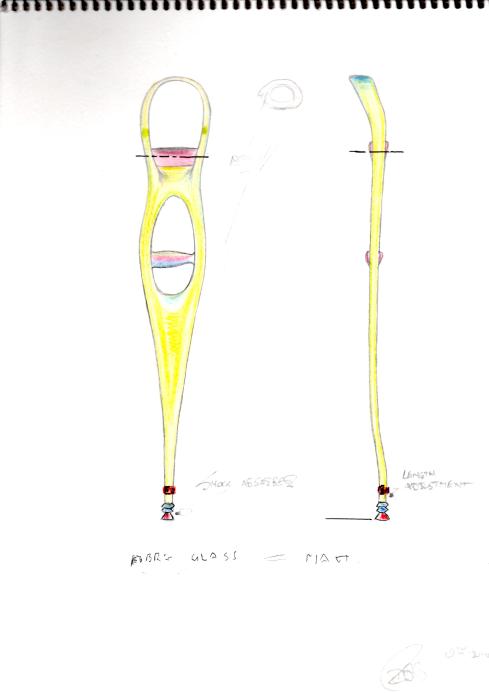
His crutch was made of fibreglass rather than wood or metal, wasn’t just a straight line, and also included length adjusters so that you could match the crutch to your height. I personally also really like the cheery colours.
What breaks my heart about this story is that it ends here. Why? It ends here because the father and son, ordinary people, could not pay for further development needed beyond these initial sketches. Like all creative industries, there is a difficult path to walk between doing something because it’s fun, or important, and giving away your skills and knowledge for free. To develop this idea would have taken months of work, including buying materials, making tools, testing, re-designing, testing again and more, before being able to make one that worked. After that, what do you do? As the inventor, is it worth investing all that time and money and energy into something when you only have a guaranteed market of one person with a small budget? Do you take a chance in case you can persuade others to buy it afterwards? You’d have to invest in marketing, time in sales calls and meetings, time answering the question ‘why is this better than what we have already?’. Douglas had to walk away from this.
However, going through Douglas’s sketchbooks, I found this drawing from years later:
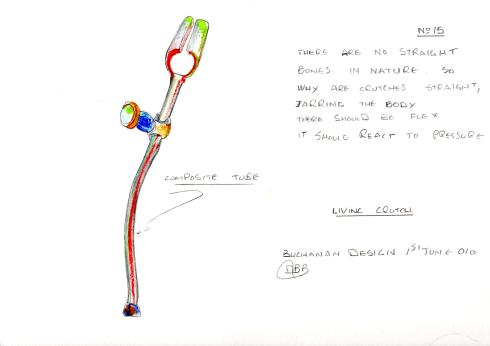
Clearly, the idea had stayed with Douglas and he had continued to think about it long after the clients had disappeared. What’s particularly interesting to me is the date. Douglas was diagnosed with Parkinson’s disease in 2002, and by 2010 he was still relatively fit and well, but had been coping with a life-altering disease for several years, as well as having a small car accident that fractured a vertebrae and put him into hospital briefly. He recovered from the accident pretty well, but bodies and aids and designs that helped rather than hindered people began to crop up more in his working life as he, consciously or not, began to look at the world from the point of view of someone with vulnerabilities. I’d really love to see this crutch made and tested, because I think it could genuinely improve the lives of many people who rely on them in both the short and long term. Such a shame that, once again, something as unforgiving and all-encompassing as money should get in the way of a more perfect world.
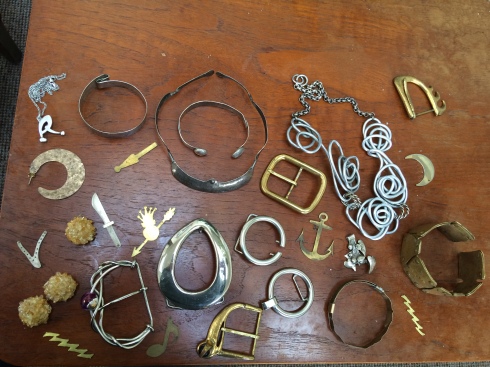
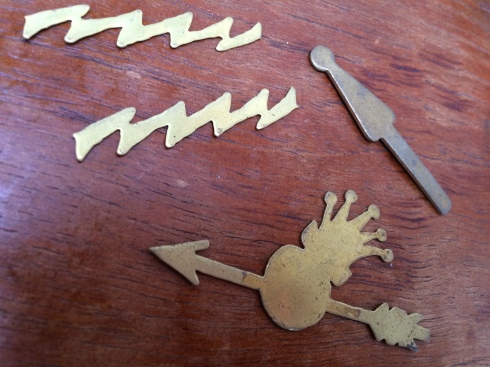 These are prototypes of what I think are brooch pins Douglas made for a company named something like Pure Fabrication. I’m fairly sure they don’t exist any more, but I like the fun and energy of these, showing Douglas on a whimsical day.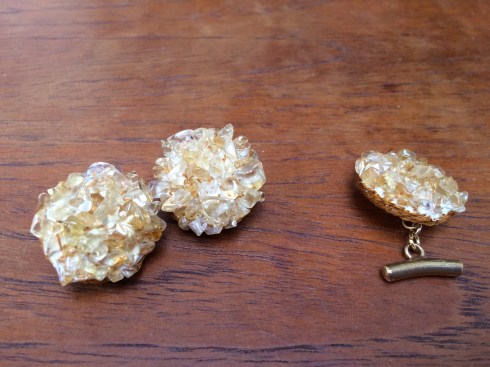
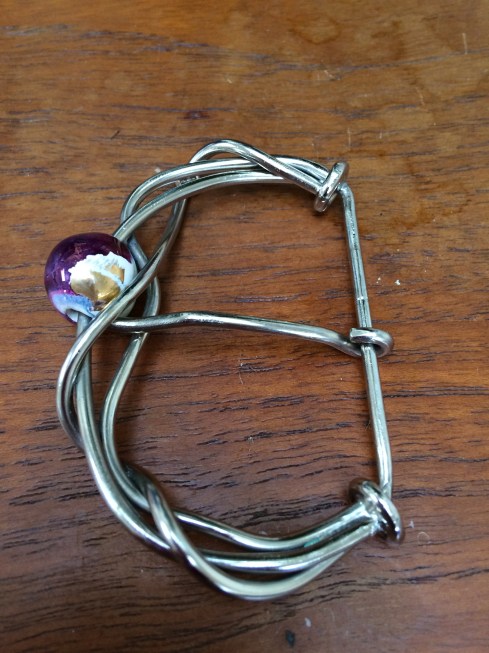
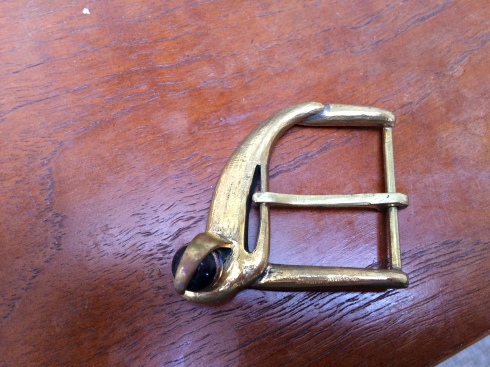
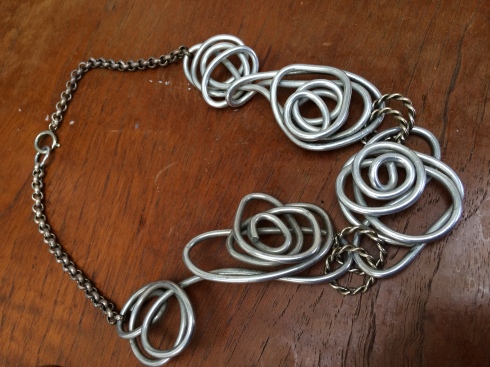 This necklace is made from aluminium wire twisted to look like spaghetti, and they came with matching bracelets and brooches. I know, because I made a lot of the twisted wire sections, sitting in the workshop learning how to shape the metal into twists that were tight but not too tight. Some of them were sprayed with gold, and others were left silver. I wear this one a lot, and get a lot of comments about it still. Not all of his jewellery is wearable, however. Take a look at this:
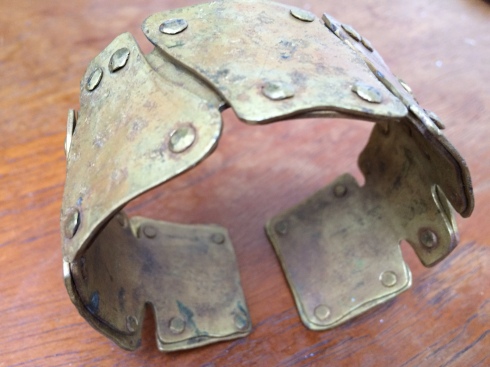 I really love this bracelet. I like it’s semi-organic shapes, it’s post-apocalyptic armour chic. However the thing is so enormously heavy that it is impossible to wear for more than a few minutes before you want to throw it across the room. This was a common problem with Douglas’s jewellery ideas, not all of them were practical. However, he did make me some lighter, very pretty and wearable pieces like these:
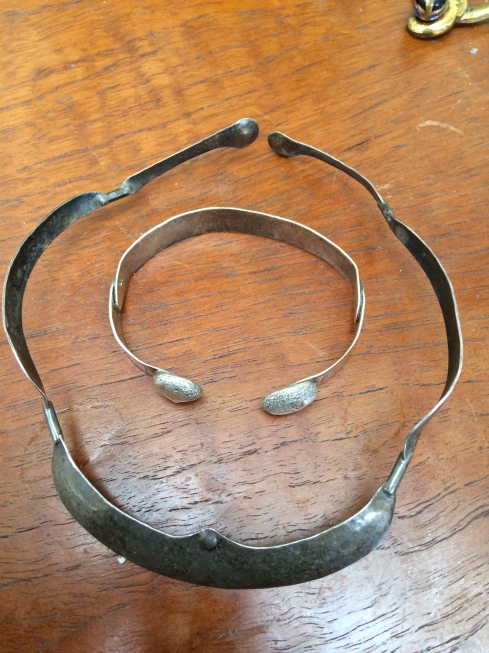 The silver needs a bit of a clean, but I wore them a lot. He also made me some pendants. Here are two of them: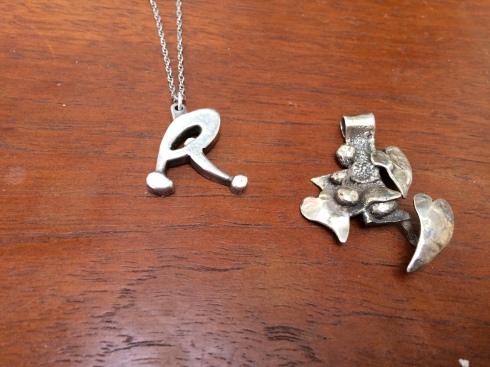
 And inside: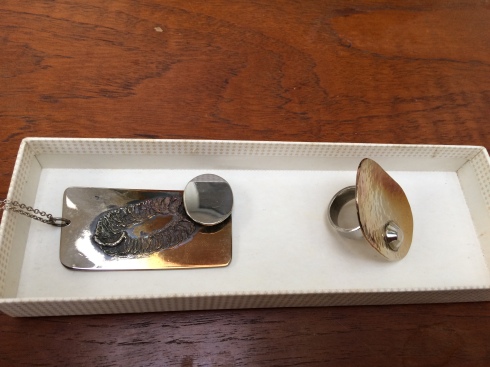








 It looks to me like a sail, with a person lying underneath it. The notes read ‘operates in best @snorkel depths’ and ‘pre-shaped sail.’ Here’s another one (it’s faint, apologies for the very poor copy):
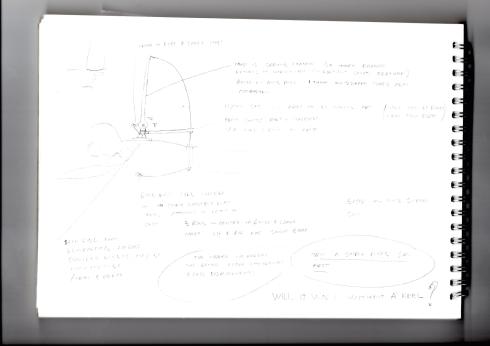
 The note on the right shows doubt: ‘This probably won’t work If it does it may slowly It will take some/a lot of power to move the human body under water’ but he’s added a keel filled with stones, a fibre glass mast, and noted that ‘the swimmer may have to rest stomach in’. The development continues the next day: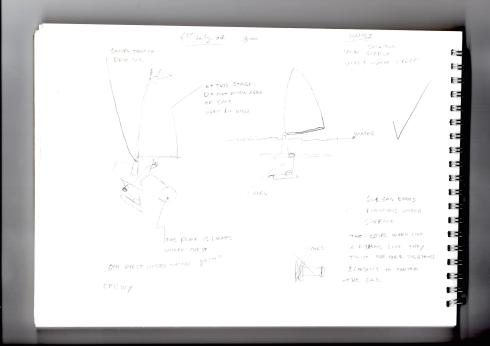

 The Underwater Bike and Other Stories